
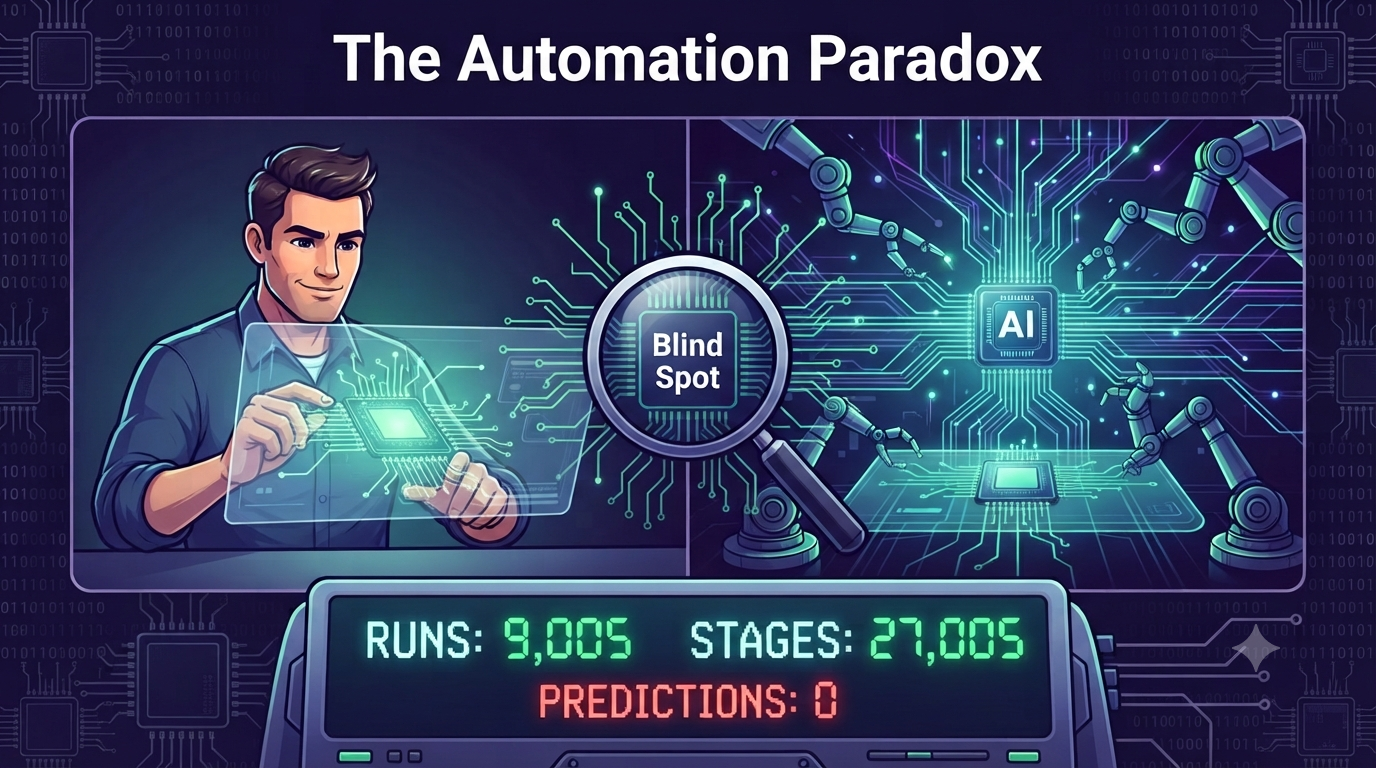
We call an agent autonomous when it runs a thirty-stage flow overnight and hands back a clean report by morning. But look at what it ran. It was our flow, our decomposition of the problem, our abstractions, our metrics, our definition of done, executed faster and without complaint. Nothing about the method changed. Only the executor did. So set up the experiment that question deserves: hold the methodology fixed, swap the human executor for an automated one, and ask precisely what scales.
This is the cleanest way to think about automation, because it is the cleanest way to isolate its effect. In a controlled experiment you vary one thing and hold everything else constant, so that whatever changes in the output can be attributed to the one thing you touched. Here the one thing is the executor. The plan stays fixed. The stage list stays fixed. The pass criteria stay fixed. We run the identical procedure two ways, once through a person and once through an agent, and we read off the difference. The temptation is to answer in a single word: speed. That answer is true and it is almost worthless, because it describes the one variable everyone already agreed to measure and stays silent on every variable nobody set up a column for.
Automation is faithful, and that is the risk
Start with the property that makes automation valuable and turn it over, because the same property is the whole paradox. Automation is faithful. It scales whatever you hand it, with no opinion whatsoever about whether the thing is worth scaling. It does not evaluate the methodology. It executes it. It has no independent stake in whether the procedure it is repeating is a good procedure; it repeats it because repeating it is the job.
Hand a faithful executor a good method and it multiplies the good. It takes a sound checking procedure and applies it a thousand times without the drift, the fatigue, the Friday-afternoon shortcut that a human introduces on the nine-hundredth repetition. This is the case everyone sells, and it is true. But faithfulness does not know the difference between a good method and a partly-flawed one, and here is the sentence that ought to sit uncomfortably: every method is partly flawed. There is no procedure in verification, or anywhere else, that carries no unexamined assumption inside it. So hand the same faithful executor a method with a flaw in it, which is to say hand it any method at all, and it multiplies the flaw with exactly the efficiency it multiplied the competence, and more consistently than any human ever could.
This inverts the usual comfort. We tend to assume that better automation is safer automation, that the more capable the tool the more it protects us. The opposite is closer to the truth. The better the automation, the more permanently it encodes whatever was wrong with the method, because better automation means less deviation, and less deviation means the flaw is reproduced more exactly, in more places, with fewer of the accidental interruptions that a clumsier process would have introduced. Capability is not a correction. Capability is amplification, and amplification is neutral about what it amplifies.
Four things scale together, and we count one
When you automate a methodology you are not scaling a single thing. You are scaling a bundle, and the bundle has at least four strands twisted together so tightly that no tool can pull them apart:
- The knowledge we meant to scale. The competence, the checks that catch true defects, the procedure we are proud of. This is the strand we intended, and the only one we celebrate.
- The assumptions we made without noticing. The things the method takes as given because someone, long ago, decided they were safe to take as given, and no one has revisited since.
- The habits we never questioned. The way we always order the stages, the check we always run first, the corner we always skip because it never mattered before.
- The blind spots we cannot see by definition. The failure classes our method was never built to look at, invisible to us precisely because our method is what defines what we look at.
Automation cannot distinguish these four. They are not labelled in the flow. Nowhere in the procedure is there a tag that reads this step is competence and another that reads this step is an unexamined assumption you will regret. To the executor they are all just steps, identical in kind, each one a thing to be carried out and reproduced. So the agent scales all four with one indiscriminate motion. It multiplies the knowledge, and we applaud. It multiplies the assumptions, the habits and the blind spots with the same stroke, and we say nothing, because we never had a name for the other three and we certainly never had a metric.
This is the shape of the paradox, and it is worth stating precisely so it cannot be softened into a warning about buggy tools. The paradox is not that automation fails. Automation succeeds. It reproduces our limitations with the same fidelity it reproduces our competence. A failing automation would be easy; we would notice, and fix it. A succeeding one that faithfully mass-produces the three strands we were not counting is the harder thing, because everything it does looks like success, and by every metric we set up, it is.
The evidence, from our own house
We do not have to argue this in the abstract, because it has already happened to us, and we can read it off a live query. One of our own engines keeps an intelligence database of everything it has ever done. It is not a demo and it is not a sketch; it is the accumulated record of the tool running its methodology over and over. Ask it what it contains, and it answers plainly:
The database scaled everything the methodology told it to scale, exactly as instructed, and nothing it did not. The last row is not a defect. It is the shape of the method, stamped nine thousand times.
Read those numbers as an experiment result, because that is what they are. Nine thousand runs. Twenty-seven thousand stages. Nearly a thousand coverage measurements, carefully taken and stored. And zero predictions. Not one. The zero is not a bug and it is not an outage. It is the methodology reproduced with perfect fidelity. The method this engine was given says, in effect, record what happened, do not forecast what will. Measure the present, log it, move on. And the automation obeyed that method with total faithfulness. It scaled the recording to nine thousand runs, and it scaled the foresight to nothing, and it scaled both of them identically, because to a faithful executor recording and not-forecasting are the same kind of instruction: a thing the method says to do, or a thing the method never says to do, carried out the same way every time.
Now name the blind spot exactly. It is this: we do not learn forward from our own evidence. We sit on nine thousand runs of ground truth, the richest possible material for anticipating the next failure, and we forecast nothing from it. And here is the part that matters for this article. That blind spot was not introduced by the automation. It was there in the method before the first run. What the automation did was preserve it, perfectly, and stamp it 9,005 times without a single deviation. A human running this methodology by hand would, somewhere in nine thousand repetitions, have gotten curious, glanced at the pile of data, and idly wondered what it predicted. The automation never wondered. It was too faithful to wonder. The zero is the sound of a blind spot being reproduced without interruption.
What automation quietly removes
To see why the automated executor never wondered, look at what it took out of the process when it replaced the person. It did not add anything to the method; the method was fixed by the terms of the experiment. What it removed was variance.
A methodology executed by people carries variance in every run. No two humans run the same procedure identically, and no single human runs it identically twice. Some of that variance is exactly the harmful inconsistency we automated to be rid of: the skipped step, the missed check, the misread number, the corner cut under deadline. We were right to want that gone. It causes escapes and it wastes debug cycles and it is nobody's idea of a defensible process. If removing that were all automation did, the paradox would not exist.
But the same variance that holds the harmful inconsistency also holds something else, and the two are not stored in separate bins. Variance is also where the occasional useful deviation lives: the result someone stopped to question because it looked slightly off, the off-script hunch that ran a check the flow did not call for, the accident that stumbled into a corner the method was blind to and caught a flaw nobody was looking for. These are not reliable and they are not frequent, which is exactly why we never counted them. But they are made of the same substance as the errors, because both are departures from the exact procedure, and a departure is a departure.
Automation does not distinguish between the two kinds of departure, for the same reason it could not distinguish the four strands: neither is labelled. It collapses variance to zero. It removes the harmful inconsistency we meant to remove, and in the identical motion it removes the useful deviation we never counted, because both of them are variance and variance is the thing that got removed. This is not a romantic point about the nobility of human error, and it should not be read as one. Human error is mostly just error. The point is narrower and colder: a flaw that used to fire intermittently, because human variance occasionally jostled the process off its rails and interrupted the flaw by accident, now fires every time, everywhere, forever, because there is no more jostling. Consistency did not fix the flaw. Consistency made the flaw perfect.
The consistency trap
Follow that one step further, because it closes a door people assume stays open. The usual reassurance about a flawed automated method is that we will catch the flaw eventually, the way we always have, by someone noticing something odd. But notice how, historically, we noticed. A slow human running a flawed method occasionally broke it by accident, and sometimes, not often, that accident was the only thing that ever caught the flaw. The escape was found not because the method was designed to find it but because the executor deviated from the method just enough to fall outside its blind spot for one run.
Automation removes even that. The same consistency that removes human error also removes accidental discovery, and it removes them together because it is not choosing between them at all. It is not weighing the value of a discovery against the cost of an error and deciding. It is eliminating variance, and both the error and the discovery live inside variance, so both go. The method that used to be saved, now and then, by its own imperfect execution is now executed perfectly, which means it is now blind perfectly, which means the one historical mechanism that used to rescue us from our own blind spots has been engineered away in the name of reliability.
What would be different
So it is fair to ask what an executor would have to do to escape this, and the answer draws a sharp line between execution and something else. Everything the paradox describes is faithful execution scaled. To break out of it, an agent would have to do something that is not execution at all. It would have to:
- Invent a metric we did not define: not close a coverage number we set, but decide that the number we set measures the wrong thing and propose a different one.
- Discover a dependency our model never represented: not traverse the graph of couplings we drew, but find a coupling that was never in the graph.
- Challenge a specification instead of implementing it: not build what the spec says, but come back and argue the spec is asking for the wrong behaviour.
- Create a category of test nobody asked for: not run the test plan, but notice a failure mode the test plan has no section for and write the section.
- Refuse our decomposition and propose its own: not fill in the boxes we drew around the problem, but redraw the boxes because ours cut the problem badly.
Each of these is an act of imagination, not execution. Each requires stepping outside the method to judge the method, which is the one move a faithful executor is constitutionally built not to make. And it is worth saying plainly that none of our agents do any of these, and neither, in candour, do most of the systems being sold as autonomous. What they do is execute our methodology at scale, superbly, which is a large and useful thing and is not the thing the marketing word promises. Autonomy in the sense that matters is not running our flow without us. It is questioning the flow we would have run.
The frontier was never speed
Come back to the experiment and read its result cleanly, now that we know what to look at. We held the methodology fixed and swapped the executor, and what changed was not one variable but a bundle. Speed went up, which we measured. Variance went to zero, which we did not. And inside that vanished variance went both the errors we were glad to lose and the accidental deviations that were, historically, the only thing that ever caught the flaws our method could not see. The automation reproduced our competence and our blind spots with equal fidelity, because to a faithful executor they were never distinguishable in the first place. A perfectly automated flow gives you your own methodology at scale: the knowledge and the assumptions, the habits and the blind spots, competence and limitation alike, with a consistency so complete that it removes even the accidental escapes we used to be rescued by.
Which is why the question we ask before we automate is the wrong question. We ask how fast it will run and how many designs it will cover and how many nights it will work unattended. Those are questions about the strand we were already counting. The question the experiment poses is quieter and harder, and it is the one this article will not let you set down.
It does not only scale the method. It scales the fragmentation.
There is a second thing automation reproduces with perfect fidelity, and it is the one a system architect should fear most: not the method, but the shape of the method. Our flow is written as a sequence of boxes, each with its own inputs, its own metric, its own definition of done, because that is how humans divided the work. An agent handed that flow inherits the division whole. It optimises each stage in isolation, because isolation is what the flow described, and it has no reason to care about the trajectory that crosses the boxes, because no box ever asked it to.
A human at least carried a memory of the stage before and the stage after, and now and then reached across a seam because something felt wrong on the far side of it. The agent carries only the box it was given. So automating the flow does not merely run our methodology faster. It makes the seams permanent, and it removes the one mover who occasionally crossed them. The fragmentation we introduced for our own tractability becomes, at machine speed, a property of the design.
Before we scale a method a thousandfold, the question is not how fast it will run. It is which of its assumptions we are about to make permanent. Automation will not answer that for us, because automation has no opinion about the method it carries. It will only carry it, faithfully, into every run we give it, and stamp whatever we handed it nine thousand times without one deviation, competence and blind spot in the same indistinguishable motion. The frontier was never speed. It was the willingness to doubt the method before we made it eternal.