
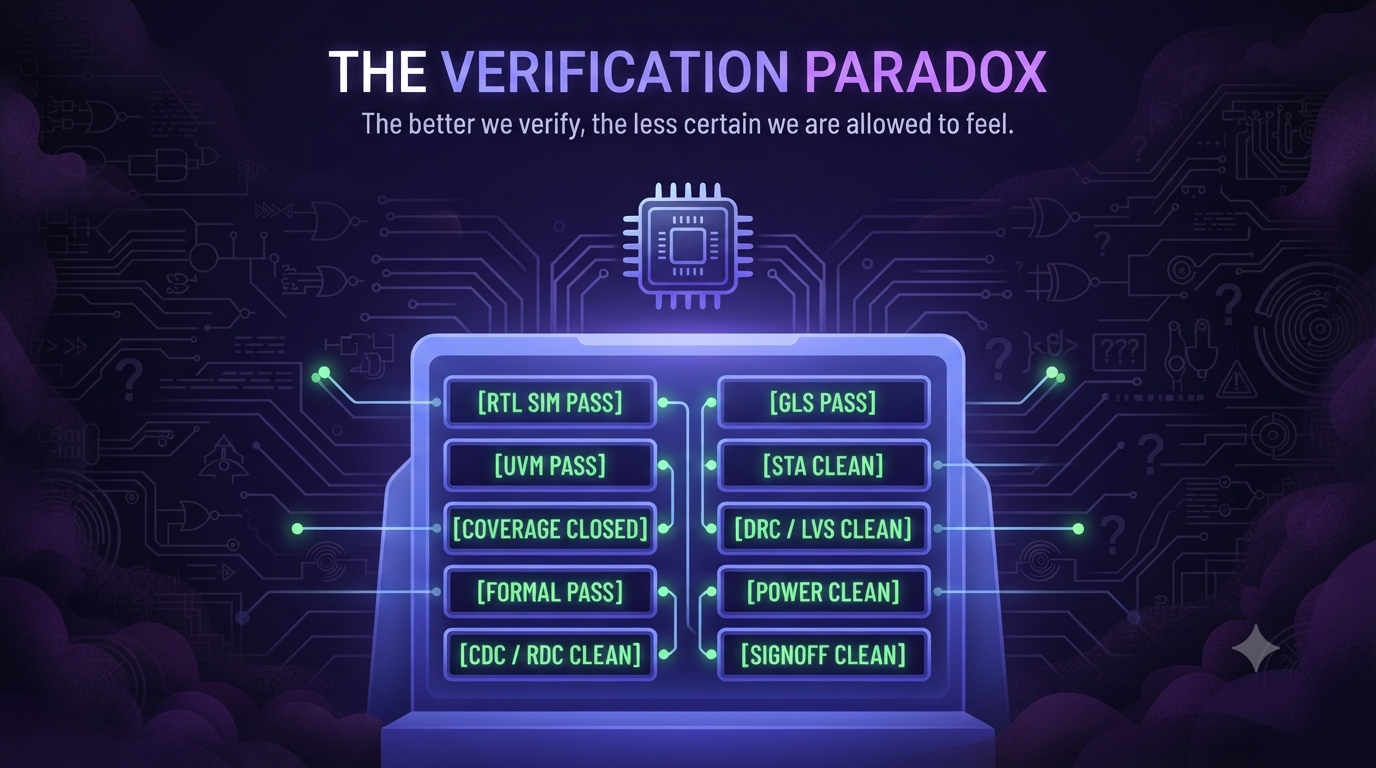
Run everything. RTL simulation, coverage, assertions, formal, CDC and RDC, gate-level, static timing, DRC, LVS, power, signoff. Every stage green. Now answer one question, and answer it the way you would to yourself and not to the review: would you press the tapeout button without fear? For most engineers, after most projects, the answer you give only to yourself is "...probably." That single word of hesitation, sitting on top of a wall of green, is this entire article.
We buy verification to make doubt go away. If it did what the dashboard implies, the emotional arc of a project would be simple: uncertainty at the start, and each passing stage quietly retiring a portion of it, until the final signoff produces something close to peace. Ten independent-looking stages, each removing a class of failure, ought to sum to confidence. The last green cell ought to feel like the most certain moment in the schedule.
It rarely does. For a lot of teams, the closer the design gets to silicon, the higher the anxiety climbs, not the lower. That is not superstition, and it is not weakness. It is the engineer understanding something the dashboard has no column for.
A choice of illusions
Here is the wall of green, rendered plainly:
If confidence accumulated monotonically, the bottom of this stack would be the calmest place in the project. It is often the tensest.
Why does the hesitation survive a perfect scoreboard? Because each of those verdicts is true in a way that is narrower than it looks. Every PASS eliminated uncertainty inside a model. Not one of them established that the collection of models contained everything that mattered. The stack proves, ten times over, that the design behaves correctly under the questions we knew to ask. It is silent, completely silent, on the questions we did not think to ask, and the engineer's discomfort is the felt weight of that silence.
So the flow does not offer us certainty. It offers a choice of illusions, and the word is not an accusation. The illusions are necessary. We cannot hold the whole chip in one thought, so we agree to look at it through a sequence of partial, tractable views, each of which is candid about its own frame and mute about the others. The mistake is not in using them. The mistake is in adding them up and mistaking the sum of partial views for a whole one.
Then why did formal arrive, if simulation and coverage were so good?
The history of verification is usually told as a ladder of improving tools: simulation, then coverage, then formal, then signoff, each better than the last. That story is wrong in a way that matters, and the way it is wrong is the key to the whole paradox. Each method did not arrive because the previous one was bad. It arrived because the previous one became good enough to reveal its own boundary.
- Simulation got good, and we started asking what it had never exercised. So we built coverage.
- Coverage got good, and we saw that visiting the states we defined is not the same as proving behaviour across the states we did not. So we reached for formal.
- Formal got good, and we asked whether we had proved the right properties, and whether an assumption had quietly constrained the bug away. So we added vacuity and assumption analysis.
- Structural analysis caught what crosses domains, gate-level caught what RTL abstracted away, timing caught what logic ignored, physical verification caught what timing ignored. Each one a boundary the last could not see.
Notice what did not happen at any step: the previous method did not die. Formal did not end simulation. Gate-level did not end RTL verification. Physical signoff did not end system validation. Each new discipline exposed a boundary of the previous one and then stood beside it, permanently. That is not the shape of a ladder climbing toward completeness. It is the shape of a thing that keeps discovering it was never complete.
And formal, the method we reach for when we want something stronger than sampling, carries the same structure inside it. A proof has a denominator too, it just does not wear a percentage: the properties we wrote, the assumptions we constrained under, the abstraction we lowered into, the states the solver represented. A proof of A ⇒ B can be valid forever and still tell you nothing, if A was not a faithful description of the world the chip will live in. Formal does not escape the boundary problem. It relocates it from "did we exercise enough?" to "did we specify the right thing, under the right assumptions?", which is a better question, and still a boundary.
Which leads to the question every candid verification lead eventually asks out loud: if coverage is mature and formal is powerful, what comes next, and why? The instinct is to name it. Adversarial AI verification, cross-domain coverage, system chaos, specification verification, something. But watch the trap: to confidently name the next methodology is to assume the next unknown already fits inside the concepts we currently possess, which is precisely the assumption this whole series exists to question. Simulation did not end verification. Coverage did not. Formal did not. Signoff did not. Each arrived because something that looked sufficient revealed a boundary. So the only intellectually clean answer to "what is next?" is the uncomfortable one: we do not know, and if we did, we would probably have already built it.
"We followed the flow" is not "we verified the chip"
An engineer can stand up and say, every word true: simulation completed, coverage target met, formal properties passed, gate-level passed, timing closed, physical checks clean, signoff done. Every one of those statements is a fact. And yet none of them, nor all of them together, logically produces the sentence everyone in the room silently appends: therefore everything capable of causing this chip to fail has been examined.
That final sentence is an inference humans make. The flow never promised it. The flow promised, precisely, that a specific list of models were exercised or proved within their frames. The leap from "the flow completed" to "the chip is verified" is ours, and we make it because the alternative, holding the residual explicitly in mind, is uncomfortable to carry to a tapeout meeting.
We divided reality; the silicon recombines it
There is a deeper reason the sum of green cells is not a whole. To make the chip verifiable at all, we had to cut it into pieces:
We split the chip into domains because a human needs tractable pieces. The manufactured part obeys no such split.
The decomposition is not optional; it is the only way the problem becomes solvable. But somewhere along the way we stopped treating the divisions as our conveniences and started treating them as properties of the chip. The chip does not know that a phenomenon "belongs to CDC," or that this is "a timing problem" and that is "physical design's job." It has no idea which team owns which failure. It experiences logic and timing and physics and environment simultaneously, in one continuous physical event, at the exact interfaces where our neat boxes meet and where no single tool was looking.
And then we blame the thing no one can see
Suppose the chip comes back and misbehaves. Notice how rich our vocabulary suddenly becomes: process variation, package effects, board conditions, analog behaviour, metastability, environmental corners, manufacturing spread, an unforeseen interaction. Some of these will be the true cause, and every one of them is physically present. But they share a quiet, convenient property that is worth saying plainly: they all sit just beyond the last boundary we believed we controlled.
So "physics" becomes available as a final place to put uncertainty. Not because physics is a fiction, but because it is the region our verification stopped at, and we are very good at giving the region past our reach a name that sounds like an external adversary rather than an internal limit. The uncomfortable question, the one this article will not let you off the hook for, is this: did physics defeat our verification, or did our verification stop at a boundary and then call everything beyond that boundary "physics"? We reach for the invisible because the invisible does not implicate us. It is easier to have been beaten by nature than to admit that, deep down, we already knew we had not done the whole thing.
The expert is more afraid than the novice, and that is the proof
Watch how fear tracks experience, backwards from how you would expect. Run only RTL simulation and you can feel oddly confident, because you do not yet know the dimensions of failure you are ignoring. Then learn CDC deeply, and metastability becomes a thing you can no longer un-see. Learn gate-level, and a universe of timing-dependent, X-sensitive, reset-release behaviour opens under your feet. Learn physical implementation, and congestion, parasitics, skew, IR, electromigration and process corners all become present for the first time.
So the novice is calm because the space of failure is small in his imagination, and the twenty-year expert is cautious because verification has spent twenty years teaching her exactly how many dimensions that space has. This is the hinge of the whole paradox, and it is not a criticism of verification. It is verification succeeding. The methods worked so well that their true product was not certainty. It was a precise, hard-won education in why certainty was never a reasonable thing to expect. A field that leaves its masters more careful than its beginners is not failing. It is teaching.
So what is verification for?
Maybe we have simply been asking it for the wrong thing. If the goal is certainty, verification will always, eventually, disappoint you. If the goal is prove the chip cannot fail, the goal is close to philosophically doomed, because it requires exhausting a space we have already shown we cannot even fully enumerate. Both framings set the tool up to look like a failure precisely when it is being most candid.
There is a different definition, and it is the one the mature engineers seem to arrive at whether or not they say it aloud. Verification is the progressive conversion of unknown risk into known risk, of known risk into bounded evidence, and of bounded evidence into explicit residual uncertainty. Under that definition a good tapeout decision is not "we verified everything," which is never true. It is something an adult can stand behind:
Here is what we tested. Here is what we proved. Here is what we only modelled, and the assumptions the model rests on. Here is what remains unobserved. Here are the boundaries between our verification domains, and the seams we know no single tool inspected. And here is the residue we are consciously choosing to accept, with our names on it.
This is the one place a WIOWIZ run belongs in this article, not as a product pitch but as a demonstration that the conversion is buildable. A tool that closes with UNVERIFIED and names the 130 constructs it could not model, or that prints its untested count beside its clean one, is not being timid. It is doing the exact conversion above: taking a piece of unknown risk and turning it into explicit residual uncertainty that a human can see, weigh, and own.
$ vajra-lp close wzax1_top.upf
  closure : UNVERIFIED   # not a failure. a residual, made explicit and handed back to a person.
And with that, accountability comes home. No hiding behind "the tool passed." No hiding behind "signoff was clean." No automatic retreat to "physics happened." The tools convert what they can into visible residual, and the decision about the residual, the choosing to accept it, is ours, and stays ours.
Notice, too, that the arrangement itself does part of the deception. The stages are drawn in a column, one above the next, so a wall of green reads as a chain, each link bearing the one below it. But it is not a chain. It is a stack of separate photographs, each true of its own frame, joined to the others by nothing stronger than adjacency on a page. The completeness we feel looking at the column is a property of the layout, not of the logic.
If verification were meant to make you certain, here is the question it never stops posing: why do you know more reasons to be uncertain after twenty years of it than you did after two? The answer is the whole paradox, and it is not the failure it feels like. It is the clearest evidence that verification worked. It did not hand you certainty. It handed you an accurate map of the size of your own doubt, and asked you to sign for the part you cannot see.
wzax1_top.upf closes UNVERIFIED and names the 130 constructs it could not model, converting a piece of unknown risk into explicit residual uncertainty a person can own. The verification stack and the decomposition diagram are conceptual.