
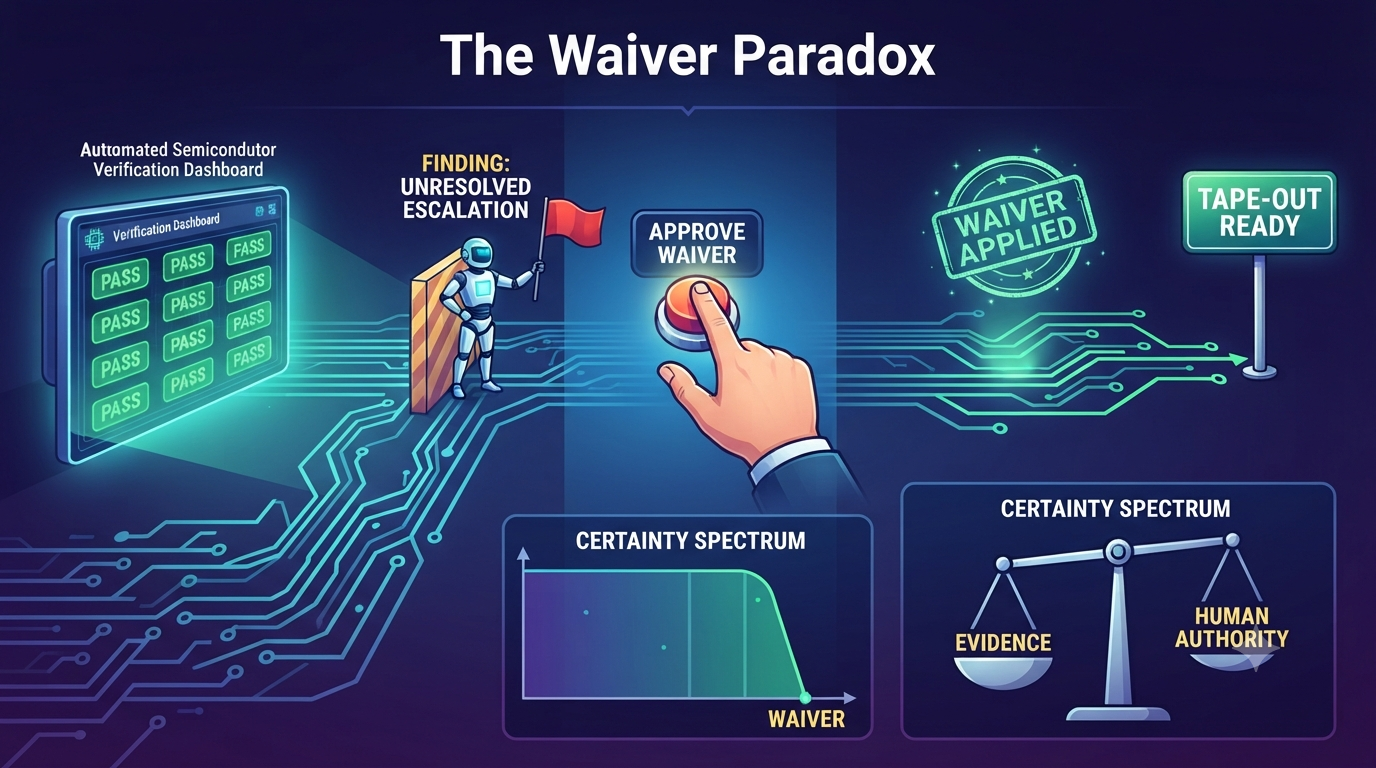
A waiver is testimony admitted without cross-examination. When you waive a finding you are not staying silent; you are asserting something strong, and you are asking a schedule to accept it on the strength of a sentence. So put the sentence on the stand and ask it the questions we ask everything else. Where is the evidence? For the one class of statement we never cross-examine, the answer, read closely, is uncomfortable: the evidence is that there was none.
Every other verdict in a verification flow has to survive something before it is allowed to be a verdict. A pass survives a run. A proof survives a solver. A timing number survives an analysis engine that will contradict it if the arithmetic disagrees. The whole apparatus is built on the premise that a claim about the design is not admitted until it has been tested against the design. That premise is the reason the flow is worth anything at all. And then, at the end, we keep one exception, and we hand it the highest-stakes decisions in the project.
What a waiver asserts
A waiver is never neutral. It always makes a claim, and the claim is always one of three propositions, each of them a statement about how the manufactured part will behave:
- This cannot happen. The condition the tool flagged is unreachable; the design will never enter it.
- If it happens, it does not matter. The condition is reachable, but its consequence is benign, absorbed, or outside the envelope we care about.
- It is covered elsewhere. Some other stage, some other check, some other assumption already accounts for this, so accounting for it here would be redundant.
Look at what each of those is. "This cannot happen" is a reachability claim. "If it happens it does not matter" is a consequence claim. "It is covered elsewhere" is a claim about the completeness and coupling of two separate verification domains. These are not administrative notes. They are propositions about the design, and they are precisely the kind of proposition that the entire discipline of verification exists to test. Reachability is what formal was built to decide. Consequence is what simulation and coverage were built to exercise. Cross-domain completeness is the hardest of the three and the one no single tool owns. Each of the three sentences an engineer types into a waiver field is a hypothesis that, anywhere else in the flow, would be handed to an engine and made to earn its verdict.
The waiver is the one place we accept the hypothesis on the sentence itself. We take a claim of exactly the type we built a whole industry to avoid taking on faith, and we take it on faith, in a spreadsheet cell, next to a name and a date.
Where the decision lands
Now watch where, on the spectrum of what we know, this decision falls. It does not fall on the proven-safe end. Proven-safe never generated a finding; there is nothing there to waive. It does not fall on the proven-wrong end either, because when something is proven wrong we do not waive it, we fix it. A waiver, by construction, cannot be applied to either pole. It can only be applied to the region in between, and that region has a name it does not like to say out loud: it is where certainty is lowest.
The two ends are unavailable by construction. The waiver can only be applied at the coordinate where the tool could not decide, which is the coordinate where the least is known.
This is not an accident of where people choose to put waivers. It is forced by what a finding is. A finding does not exist because something went wrong. A finding exists because the automated system reached the edge of what it could decide and escalated. That is the entire mechanism: a check runs, resolves everything it can resolve, and when it hits a case it cannot close, it does not stay silent, it raises the case to a human. The violation is the escalation. It is the tool saying, in the only language it has, "I could not settle this one; you settle it."
So follow the structure through to its end. The finding says: verification could not close this question. The waiver says: therefore a human closes it, with a note. We answer "the system could not tell" with "it is fine," and we file the second sentence as though it retired the first. But the first sentence was a statement about the limits of our evidence, and the second is a statement about the design, and no amount of the first has ever added up to the second. The note does not resolve the question the finding raised. It ends the conversation about it.
The burden of proof, inverted
Here is the part that should be difficult to sit with. Everywhere else in the flow, the burden of proof scales with the stakes. High-risk claims are made to survive the most. A timing signoff runs against extracted parasitics and multiple corners because we would not accept a casual assertion that the part meets frequency. Functional signoff runs regression suites and coverage models because we would not accept "it looked fine." The severity of the consequence pulls the standard of evidence upward. That is how a serious discipline is supposed to work.
The waiver inverts it. A pass must survive a run. A waiver must survive a comment. We take the highest-risk decisions, the ones about conditions serious enough to have tripped an automated check and stubborn enough that no engine could clear them, and we protect them with the weakest evidence in the entire process: an unverified sentence. The claim with the most riding on it is asked to survive the least. And then, having been written down once, it is never asked to survive anything again. The pass will be re-run next cycle and re-earned. The waiver will be inherited.
Put the two side by side and the asymmetry is stark. The green cell, which merely reports that a question was answered favorably, is regenerated on every run and can be contradicted at any time by the next run. The waiver, which reports that a question could not be answered and a person decided it did not matter, is generated once and is contradicted by nothing, because nothing re-opens it. We have arranged our evidentiary standards in exact opposition to our risk.
Uncertainty cannot be the evidence that retires uncertainty
An exclusion is itself a verification claim. That is the sentence to hold onto, because it is the one the spreadsheet format hides. When you waive, you are not removing a claim from the flow; you are adding one. You are asserting "this is not a problem," and you are asserting it in a form that looks identical, on the signoff sheet, to a claim that was proven. Both appear as closed lines. Both read as resolved. And that visual equivalence is where the fallacy hides, because the two closed lines were produced by opposite processes.
"We could not determine that this is a problem" is not "this is not a problem." The first is a statement about the reach of our tools. The second is a statement about the design. In plain logic they are not close; the first is a report of missing evidence and the second is a positive finding, and you cannot derive a positive finding from missing evidence. Absence of proof of a fault is not proof of absence of a fault. Yet once both have been written as a closed line in the same column, a signoff cannot tell them apart. The format erases the distinction that matters most, and every reader downstream inherits a document in which "proven safe" and "unexamined" wear the same color.
The convenience waiver runs on exactly this confusion. It treats the absence of a resolution as if it were a resolution. The finding fired because the question was open; the waiver retires the finding by pointing at the same openness and calling it acceptable. But the uncertainty that produced the finding cannot be the thing that discharges it. If it could, then every unresolved question would carry, inside its own lack of an answer, the license to be declared answered, and verification would reduce to the observation that we have not yet been proven wrong.
The necessary and the convenient
None of this is an argument that every exclusion is illegitimate. Some are load-bearing and correct. A test structure that is not part of the functional design will trip functional checks and should be excluded, because the check is asking a question about a thing that is not there. An analysis running under a scenario the part will never see will report a fault that cannot occur, and excluding it is not evasion, it is accuracy. There are necessary waivers, and they share a property: the exclusion is backed by an argument that stands on its own, independent of the fact that the tool happened to flag it. You could state the reason to someone who had never seen the finding and it would hold.
The convenience waiver has the opposite shape. Its justification is the finding's own inconvenience. It is applied because the flag is in the way, on a date when the flag is expensive, by someone who needs the column to be clean before a meeting. Its reasoning does not survive being separated from the schedule that produced it. And the trouble is that on the signoff sheet the necessary and the convenient are, again, indistinguishable. They are both a closed line with a name and a note. The format that cannot tell "proven" from "unexamined" also cannot tell "correctly excluded" from "excluded because it was Tuesday."
Worse, waivers accumulate, and accumulation launders them. A waiver written once for a specific reason on a specific project is copied into the next project's setup because starting from the last known-good configuration is prudent. It is copied again. Somewhere in that chain the reason stops travelling with the waiver. What began as "we exclude this because of a particular argument we could defend" becomes "we exclude this because we have always excluded this," and then becomes a line nobody remembers adding, protecting a condition nobody remembers evaluating. The institutional assumption hardens into a fact. It is never re-litigated because re-litigating settled things is expensive, and by now it looks settled. It was never settled. It was inherited. The design it was written against may not even exist anymore in the part it now silences.
The correction is mechanical, not moral
The response to all of this is not to exhort engineers to be more careful, or to write better justifications, or to feel worse about waiving. Exhortation does not survive a deadline. The response is to change what the tool will let a run do, so that the weakest form of the waiver becomes impossible to express, and the space that remains is only the space where a waiver has become an evidenced contract. Refusal has to be built into the engine as a first-class verdict that a run cannot paper over, because a verdict a run can paper over is not a verdict, it is a suggestion.
These are live behaviours in Markand STA, and each one exists to close a specific route by which uncertainty gets recycled as resolution:
VSTA-COV-0404  untested = total − analysed, on every row.  BLOCKER.
              # you may not close a run and hide the size of what you skipped.
              # the unresolved region is counted, in the open, or the run does not close.

correlation gate  the worst-slack clause can FAIL the gate. it can never PASS it.
              # a comfortable number is forbidden from retiring an uncomfortable question.

VSTA-ARC-0001  an arc that cannot bind to its own identity is REFUSED, not waived.
              # an unresolved arc does not get to become a silent assumption.
Read what each one refuses. VSTA-COV-0404 makes the untested count a computed identity, not a field someone can leave blank: untested must equal total minus analysed, on every row, and if it does not, the run is blocked. You may close a run with a large untested count, but you may not close a run that hides the size of what it skipped. The escalation stays visible with its magnitude attached, which is the one thing a convenience waiver most wants to suppress, because a waiver's comfort depends on the reader not seeing how much was set aside.
The correlation gate encodes the asymmetry from the burden-of-proof argument directly into the arithmetic. Its worst-slack clause is allowed to fail the gate and is forbidden from passing it. A bad number can stop you; a good number cannot clear you. This is the precise mechanical form of "uncertainty cannot be the evidence that retires uncertainty," because it denies a comfortable headline the power to close an uncomfortable question. The number can raise an alarm. It is structurally unable to silence one.
And VSTA-ARC-0001 takes the hardest case, the timing arc that cannot bind to its own identity, and refuses it rather than waiving it. An arc the engine cannot tie to a known element is exactly the kind of thing a convenience flow would wave through as a rounding concern. Refused means it does not quietly become an assumption the rest of the run leans on. It stops the run and demands resolution, because an unresolved arc admitted silently is an unexamined line wearing the color of a proven one, which is the disease this entire article is about.
The common thread is that refusal is made explicit and given standing. A run cannot talk its way past a BLOCKER, and a deadline cannot talk the tool out of one. The point is not that the tool is stern. The point is that the tool's verdict cannot be overwritten by the human convenience that a waiver, by its nature, exists to serve.
"Zero waiver," stated precisely
It would be a misreading to take all this as "never exclude anything." That position is both wrong and unbuildable, because some exceptions are legitimate and a flow that could not express them would be lying in the other direction. "Zero waiver" does not mean the exclusion count is zero. It means something narrower and harder: an exception may not be justified by the same uncertainty that produced it.
The uncertainty that raised the flag is disqualified, permanently, as the reason to lower it. To stand, an exception has to stop being an exception and become an evidenced contract, defeated by something the flag was not, a reachability proof, a consequence argument, a bounded assumption stated in the open and checkable by someone who was not in the room. The exclusion survives if and only if it has been converted from "the tool flagged this and we decided to look past it" into "here is the independent reason this condition is bounded, and here is how you would check it." That conversion is the whole of the discipline. Before it, the waiver is testimony without cross-examination. After it, the testimony has been cross-examined and it held, and the line on the signoff sheet finally means what its neighbors mean.
And a waiver does one more quiet thing, which a later paradox will follow. It is not only where investigation is allowed to stop. It is where ownership is allowed to stop. The moment the exception is filed, the question leaves the room with a signature on it, and the signature owns the sentence, not the silicon. The exclusion closes the ticket and, with it, the last place anyone was accountable for what it excluded.
The exclude button is pressed at the point of least knowledge and revisited at no point at all. Sit with the full shape of that. It is the most confident act in the flow, placed at the coordinate of lowest evidence, and then sealed against review forever. Even a waiver that is correct is a standing claim about the manufactured part, and it is the one claim we have promised ourselves we will never re-open. For that reason alone it should carry more evidence than a pass, not less, because a pass will get another chance to be caught and the waiver will not. We have it backwards. We put our least evidence behind our most permanent decision, and we call the column clean.